Back to Projects

High-Performance Electric Skateboards

Two purpose-built electric skateboards that fixed the safety, speed and stability flaws of early consumer boards.

Mechanical Design Electronics Integration Vehicle Dynamics Prototyping
High-Performance Electric Skateboards

Early consumer e-boards cut power without warning, dropped their remote link and ran unprotected batteries — and standard longboard decks got dangerously unstable at their advertised speeds. I designed two boards, each tuned for one riding style, that solved those failure modes.

What I Did

  1. 01 Picked every electrical component around a failure mode: ESCs with real overcurrent protection, a remote link that doesn't drop, and BMS-protected cells.
  2. 02 Matched deck construction to the job — a flexible bamboo deck for a 28 mph all-terrain board and a stiff maple deck for a wobble-free 40 mph board.
  3. 03 Speed- and wobble-tested both boards at target velocity and validated the overcurrent and remote failsafes.
  4. 04 Re-tuned deck profiles and ESC settings from rider feedback gathered on forums and Reddit.

Technical Highlights

01

Deck stiffness tuned to speed

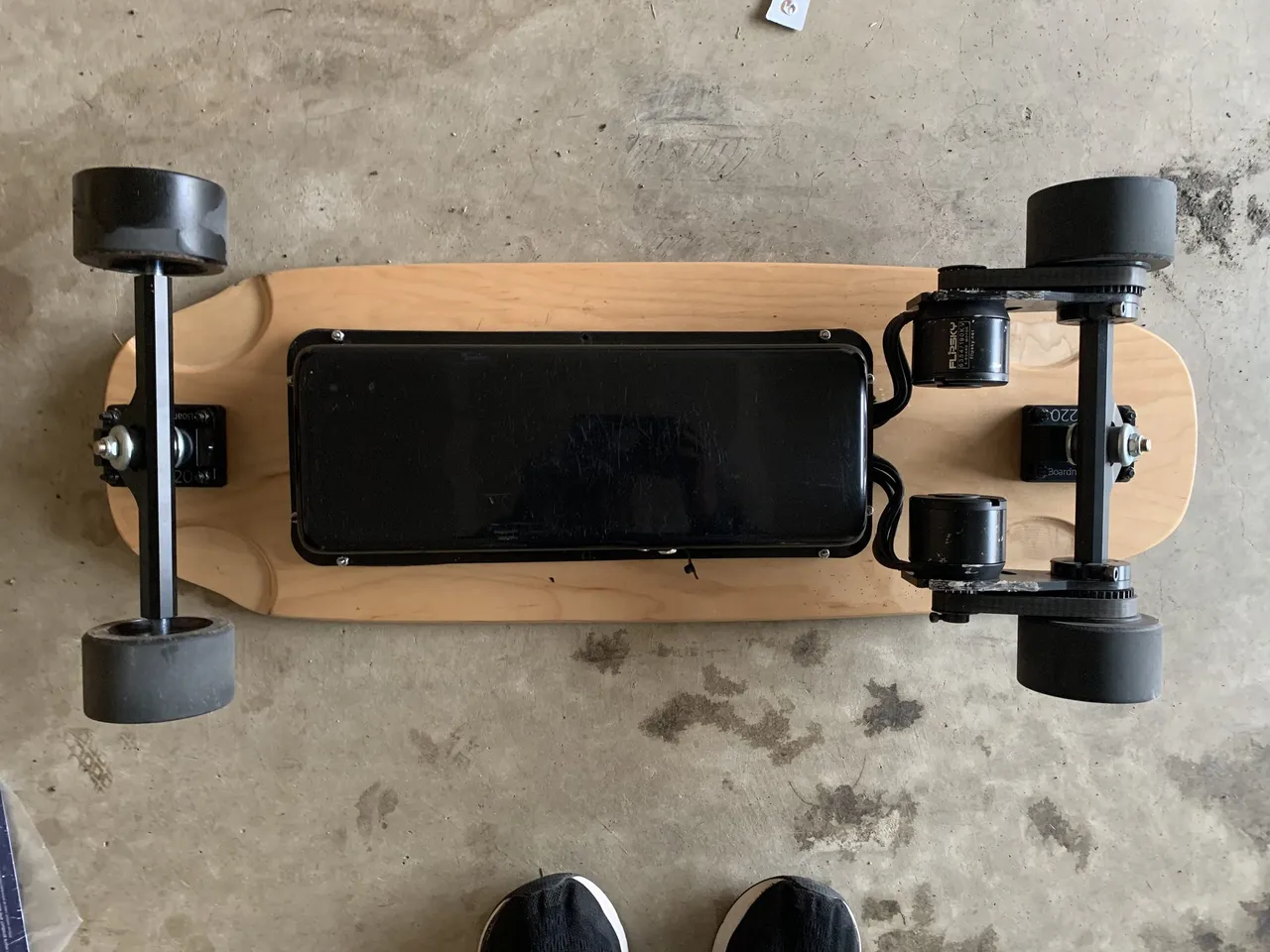
Wobble at speed comes from a deck that flexes and lets the trucks oscillate. The two boards take opposite approaches on purpose:

  • Bamboo all-terrain board (28 mph): flexible bamboo composite that soaks up rough pavement and carves well, paired with a high-torque setup for hills.
  • Maple high-speed board (40 mph): stiff maple layup that keeps the trucks planted and the board tracking straight.
The two deck shapes after cutting.
Edge of a deck, showing the laminated plies.
Deck shape modeled in CAD.
Top view of the deck outline in CAD.
02

Designing out the failure modes

Every component choice traced back to a specific way consumer boards were failing riders:

  • Sudden power cuts → ESCs with proper overcurrent protection and smooth power delivery.
  • Remote disconnects at speed → a reliable remote link with tested failsafe behavior.
  • Battery fire risk → properly rated cells with BMS protection.
Motor mount and drivetrain modeled in CAD.
Wiring and setting up the electronics.
03

Designing for riders, not just myself

The first prototypes reflected my own riding preferences. Feedback from forums and Reddit showed most riders cared more about comfort and predictable braking than raw speed and hard acceleration, so I re-tuned deck profiles and ESC settings for that market.

Rider feedback on a Reddit launch post.
Deck listed for sale on the brand website.

Gallery

A finished board outdoors.
Board with riding gloves and the remote.
Render of a complete board.